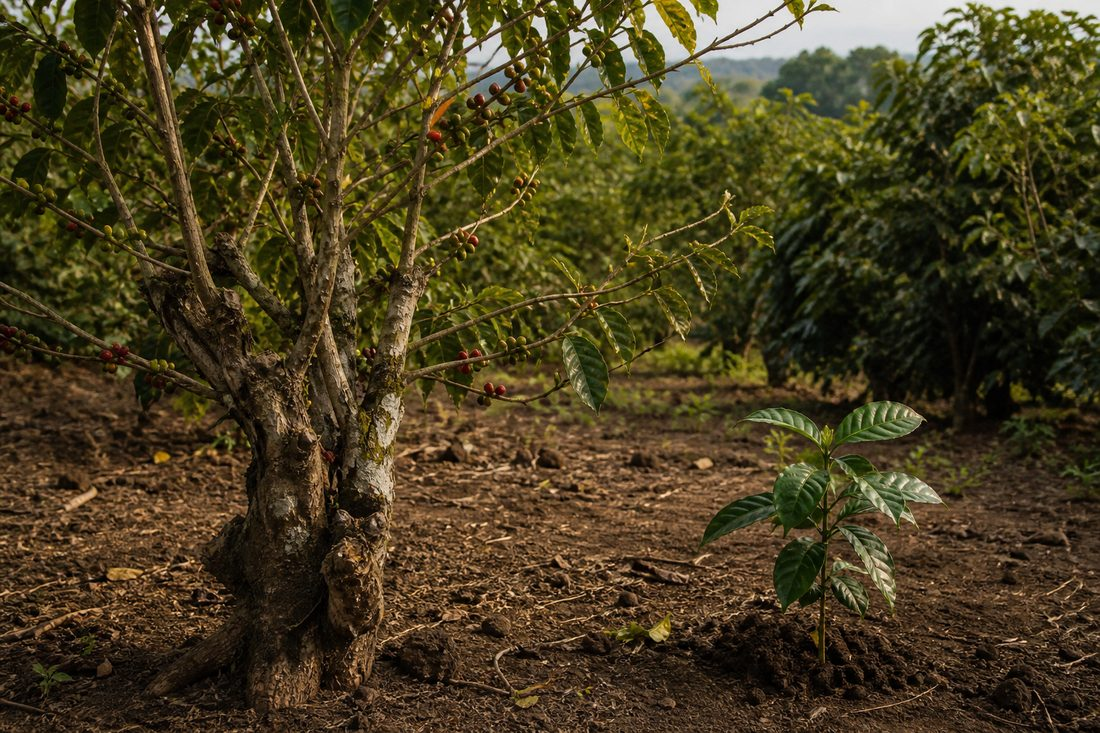


The USDA’s 2026 Coffee Annual for El Salvador (report ES2026-0004, 20 April) puts numbers on a fact the grower already sees on the slope: many trees are more than 25 years old and have passed their productive life. A coffee tree is not eternal. After two and a half decades, leaf falls, cherry falls and vulnerability to leaf rust rises. Renovation is not an ornament of agricultural policy: it is replacing the skeleton of the forest that gives the cup.
The arithmetic of the plant
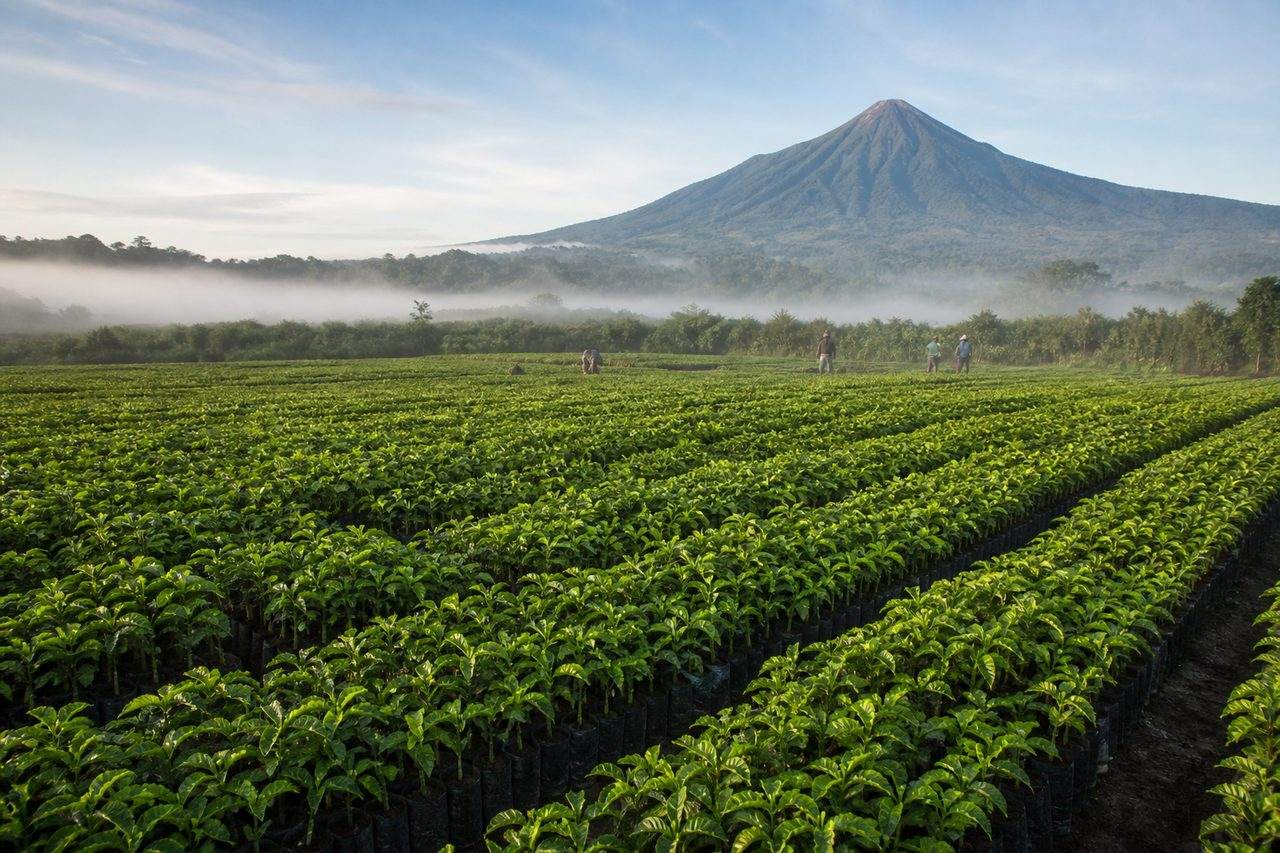
Each year more than 7 million plants must be replaced merely to cover those that die naturally. That does not enlarge the stock: it barely keeps it from shrinking. The Salvadoran Coffee Association estimates that about 30 million high-quality, rust-resistant plants a year for 10 years would be needed to truly renovate the country’s coffee areas. The gap between 7 and 30 million is the gap between surviving and rebuilding.
Harvested area, however, holds steady at about 118,000 hectares (cycles 2024/25, 2025/26 and, in forecast, 2026/27). Stable surface is not stable production. National yield averages 4.97 bags of 60 kilos per hectare in marketing year 2025/26: a low figure, attributed by the USDA to the lack of a renovation program covering most of the area.
The Government (GOES) concentrates support on small producers with less than 3.5 hectares, who represent about 15% of planted area. The report notes that a more effective renovation should include medium farmers, who hold around 37% of the surface. The seeds the State delivers are mainly Cuscatleco, Marsellesa, Pacas, Pacamara, Sarchimor and Anacafe 14, and they go predominantly to the smallholder. Cuscatleco, Marsellesa, Sarchimor and Anacafe 14 bring rust resistance; Pacas and Pacamara bring the cup profile the world associates with El Salvador. The nursery, again, has to serve both crafts: not dying of fungus and not losing character.
Without private credit, the plant stays in the bag
Private banks still see coffee as a high-risk investment and are reluctant to lend. Without financing for planting and upkeep, many seedlings go unplanted or fail for lack of inputs and care. The fact is hard and didactic: delivering the plant is not enough if there is no credit for the hole, the fertilizer and the three years of waiting until the first serious harvest.
Anyone who buys Salvadoran coffee does well to understand this count. A 90-point Pacamara is born of a tree in its best years, not of a trunk more than 25 years old. Thirty million plants a year for a decade is the order of magnitude the trade puts on the table. Until that scale arrives, the country will keep offering extraordinary lots on a stock that, on average, yields 4.97 bags per hectare. Specialty does not contradict renovation: it requires it.