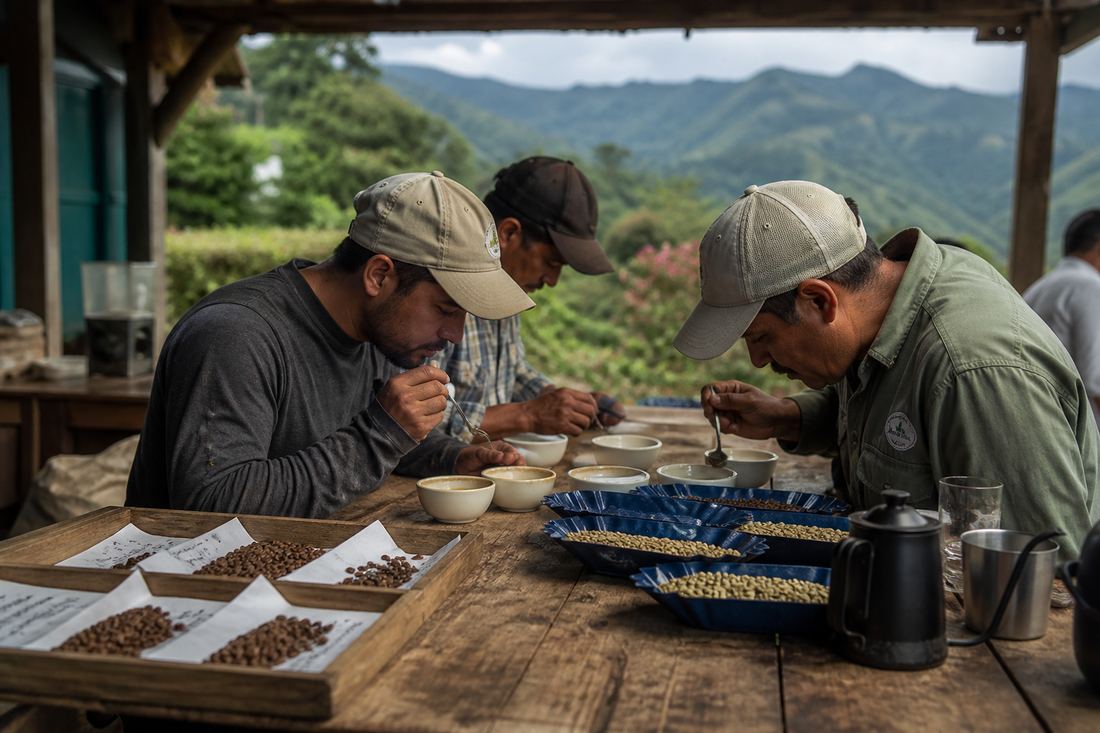


In the global coffee market, mixed origin still leads in volume. Mordor Intelligence, in its coffee-market reading, places mixed-origin offerings at 79.88% of 2025 revenue; single origin and specialty, by contrast, are the stretch that gains traction, with a projected compound rate of 6.86% a year between 2026 and 2031. It is not a reversal of tonnes. It is a shift of taste: the buyer who asks for farm, altitude and authenticity pays for another conversation.
That conversation is the natural circuit of Salvadoran coffee. The country does not compete as a sea of quintales. It competes as a named cup. USDA Coffee Annual ES2026-0004 — published 20 April 2026 — describes a growing group of producers who focus on microlots of 5 to 100 bags and nanolots of fewer than 5, aimed at specialty buyers in the United States, Europe and Asia. The scale matches what single origin demands: a lot that can be told, not an anonymous container.
Traceability, denomination and what a blend cannot copy
A blend serves an honest function: stable profile, price, chain espresso. Single origin serves another: terroir. In El Salvador that promise has six public ISC names: Apaneca Ilamatepec, Cacahuatique, Alotepec, Bálsamo Quezaltepec, Tecapa Chinameca and Chichontepec. The holder of the registry is the State. A roaster who prints the mountain range on the bag is not inventing a slogan; they are using a distinctive with altitude and use rules.
The trend Mordor summarises — blend dominant, single origin faster — explains why a Metapán Pacamara or an Ilamatepec Gesha travels as a microlot and not as blend filler. Traceability (farm, variety, process, harvest) is the price argument. The USDA also notes gourmet premiums of 100 to 300 dollars per quintal over the C Contract for quality and competition coffees: the same single-origin logic, measured in dollars.
Mordor adds the taste frame that pushes that stretch: demand for premium and specialty coffee, interest in unique flavours and in the bean’s story. The Salvadoran producer already grows that story — shade Bourbon and Pacas, Pacamara born here, Bernardina found on a farm, competition African varieties — provided cherry is picked ripe and the mill is not improvised. A microlot of forty bags does not fill a ship; it fills a menu.
No one asks for the blend to vanish. World volume needs it, and El Salvador also sells arabica that enters blends when the buyer asks. What the producer should read is the side that grows: consumers and roasters who want one origin, preferably one farm, with volcanic altitude and shade. There the country has a structural advantage. The blend dilutes; the denomination names.
Close
Taste, circuit, trend: the blend remains the ocean; single origin is the current that accelerates. Coffee from El Salvador is built for that current — denominations, microlots of 5 to 100 bags, varieties the market already names. Anyone buying blend may keep doing so. Anyone seeking a cup that explains itself should ask for a Salvadoran farm, not “a Central American arabica” diluted across three continents.