

El Salvador’s 2025 Cup of Excellence was not a single-variety contest. It was a portrait of a pantry. Perfect Daily Grind, explaining months later the rise of African genetics, underlined a figure from that edition: nine Geshas (Geisha, in the spelling Alliance for Coffee Excellence uses) were available at the auction, and two scored over 90 points. On 24 July 2025, when the CoE bidding closed, that count ceased to be a cupping anecdote and became a price.
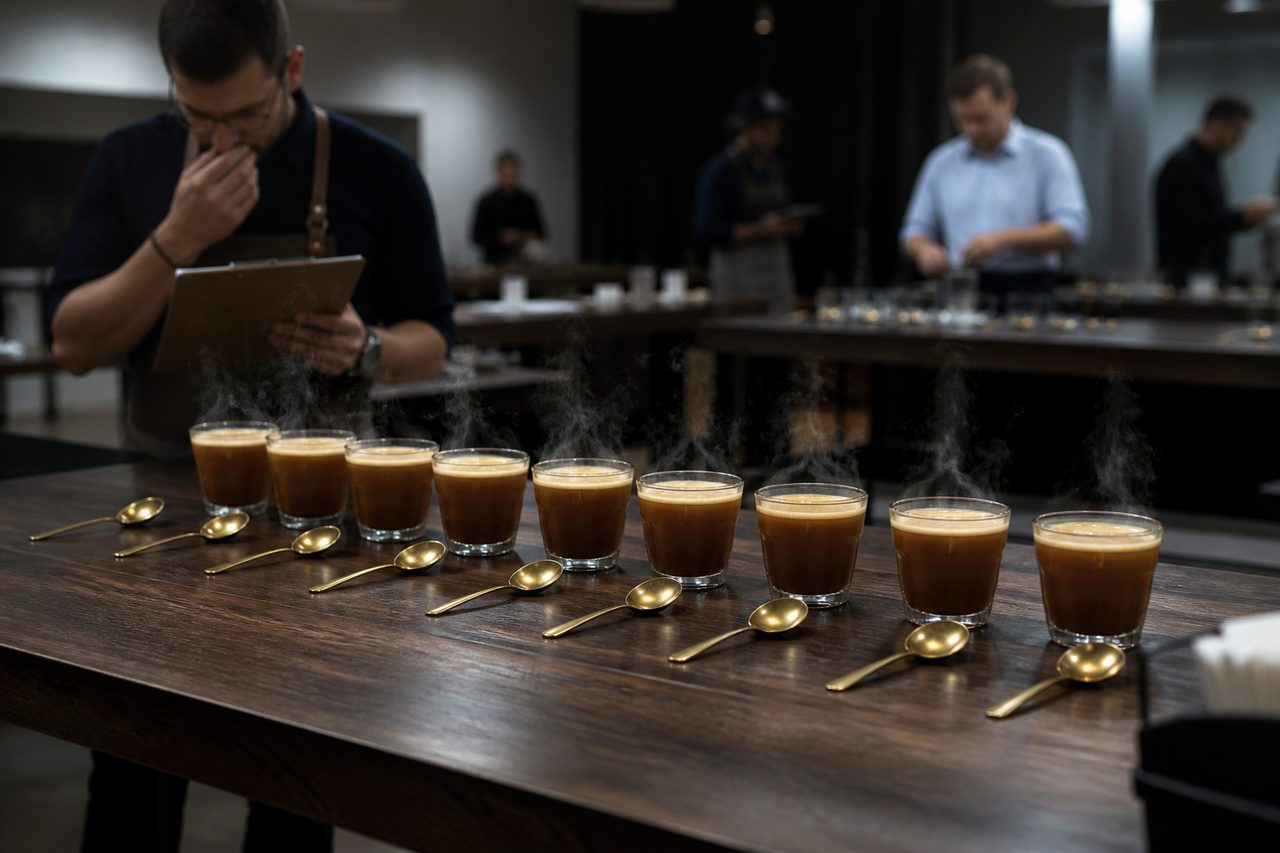
ACE organised the contest in three categories: traditional washed and honey, traditional naturals and experimental. Each sends to auction the top ten coffees scoring 87 or above, cupped at least five times. The format matters for reading Geisha: it does not compete “against the country” in a single ranking; it is measured within a process. That is why a floral honey from Apaneca and a natural from Metapán can shine at once without cancelling each other.
The 90-point coffees and the lot that went for 55.90
In washed and honeys, gold was not Geisha: it was Pacamara honey from Finca Santa Rosa (J. Raúl Rivera), Alotepec-Metapán, at 90.93. The two sublots sold at 41.20 dollars a pound (CHG / 手多多咖啡 and partners) and 42.10 (Huracán Coffee). Second place, another Pacamara honey, was Los Morales (Henri Milton Morales Umaña), 90.57. Third was the African variety: Los Naranjos, of David Velásquez Gómez, Geisha honey from Apaneca-Ilamatepec, 90.02 points, bid at 55.90 dollars a pound by MOMOS Coffee. It was the highest price of the entire 2025 CoE auction. Fourth, La Esperanza (Inversiones Santonano), Bernardina honey, closed at 89.55 and 27.00 dollars a pound, also with Huracán.
The second Geisha over 90 was not in honeys: it was in naturals. Finca La Pacaya won that category with a Geisha of 90.30. Behind it, Los Morales (natural Geisha, 89.79) and El Conacaste (natural Geisha, 89.52). ACE’s naturals list also includes Plan del Hoyo, Llano Grande and Campo Bello, all Geisha. In experimentals, Las Camelias Estate appears (natural anaerobic Geisha, 87.34). Adding the three categories — and counting La Pacaya 1A/1B as the same coffee — yields the nine Perfect Daily Grind cited.
What it teaches the buyer
It teaches, first, that El Salvador no longer “tries” Geisha: it takes it to contest with critical mass. It teaches, second, that Pacamara remains the signature of the traditional podium: Santa Rosa and Los Morales took 1st and 2nd in washed/honey. It teaches, third, that the market pays for perfume when the cup holds it: MOMOS did not buy a name; it bought 90.02 points and a Los Naranjos honey.
For the menu, the reading is didactic. A Salvadoran Geisha from 2025 may be an Apaneca honey or a Metapán natural; ask for the process, not only the variety. A 90.93 Pacamara remains the most Salvadoran argument of that harvest. Anyone who discovers both in the same auction understands the country of 2025: classic pantry and African pantry, cupped in parallel, sold to the world on the same 24 July.