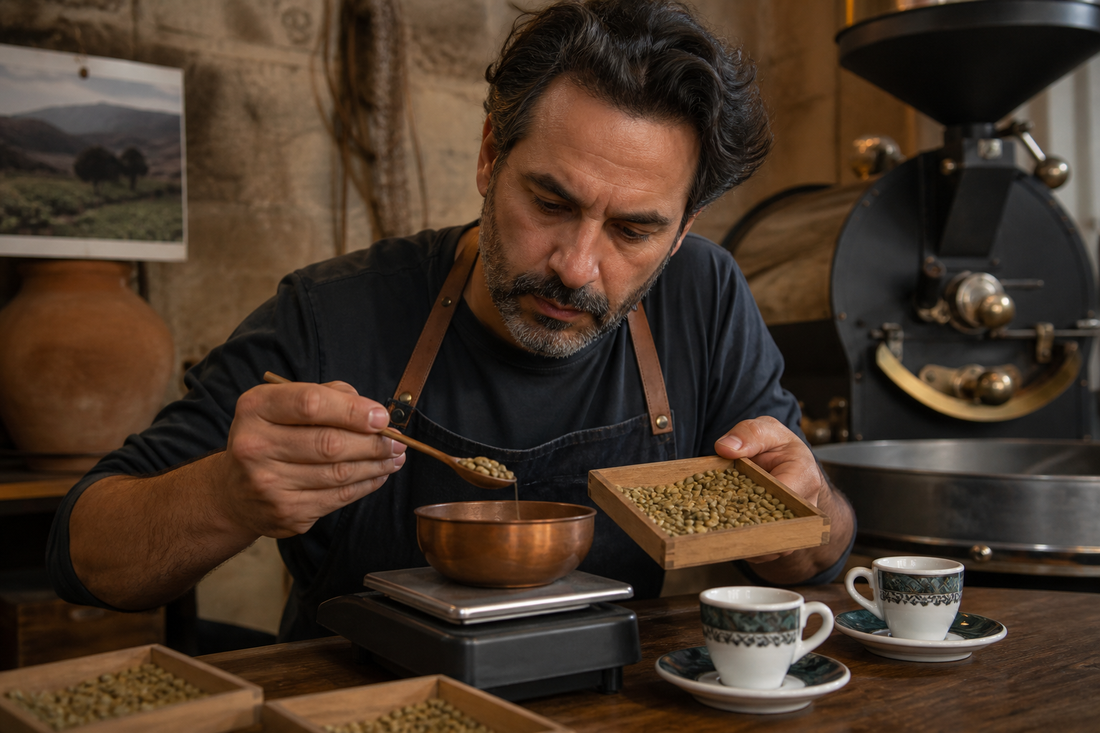


Italy understands coffee as ritual: fine grind, fast extraction, body in the small cup. El Salvador understands coffee as mountain: volcanic altitude, Bourbon, Pacas, Pacamara, competition lots. On 20 April 2026, the USDA Coffee Annual ES2026-0004 quantified the meeting: Italy received 23,005 bags of 60-kilo Salvadoran green coffee in 2025/26, projected at 23,349 in 2026/27. That is nearly 4.3% of total exports — the fourth individual destination, in the Mediterranean core alongside Belgium and Germany.
Not the volume of the United States or Belgium, but a market with memory. Milan, Trieste, Rome and Naples have imported Central American coffee for decades. What changes in the last decade is the specialty layer: artisan roasters seeking Gesha and Pacamara for filter, third-wave bars in the north and buyers bidding at Cup of Excellence auctions alongside Japanese and Korean roasters.
Traditional espresso and microlot: two valid readings
For classic Italian industry, Salvadoran coffee brings sweetness, body and balanced acidity in espresso blends — attributes of shade-grown arabica on lava. For the specialty roaster, El Salvador offers fine traceability: six ISC denominations of origin, premiums of 100 to 300 dollars per quintal over the C Contract in gourmet coffees and lots verified at CoE.
The didactic challenge is not to confuse markets. Italy does not buy only 40-dollar-per-pound microlots; it buys containers of consistent quality that feed a culture of immediate bar service. But when an Apaneca-Ilamatepec lot reaches a roaster in Turin or Florence with farm name and honey process, it competes in another league: the cup explained, not only served.
Why the Mediterranean matters for the origin
Europe is not a single block. Belgium (~11%) functions as a re-export hub; Germany (~4.2%) as industrial and specialty roasting market; Italy (~4.3%) as a Mediterranean gateway with its own palate. Together they diversify dependence on the U.S. buyer (~50%).
Anyone producing in Santa Ana, Sonsonate or Ahuachapán should read Italy as a long-relationship market: renewed contracts, certificate demands, growing interest in sustainability and traceability — themes the ISC promotes on trade missions and that converge with the European deforestation regulation. The Central Reserve Bank put Italy at about 8.6 million dollars in exports for 2024; the USDA confirms the volume in bags. Salvadoran coffee is already on the Italian bar. The opportunity is for it to arrive with variety, region and cooperative in the conversation — not only as anonymous “Central American origin.”