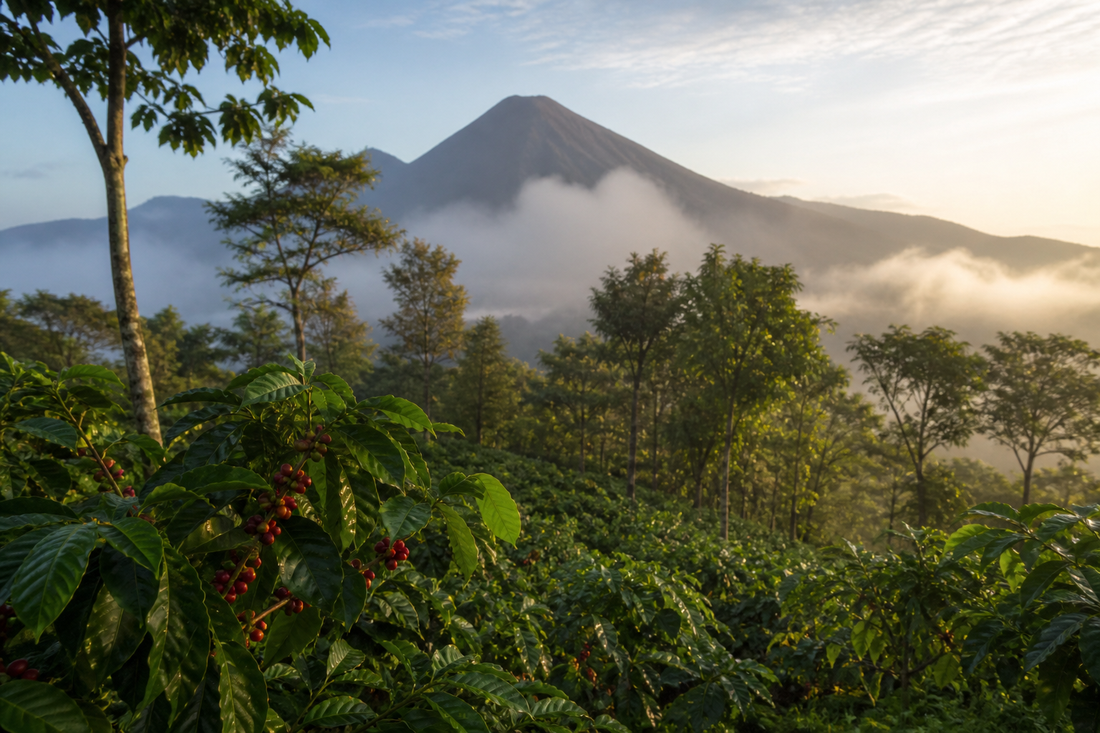


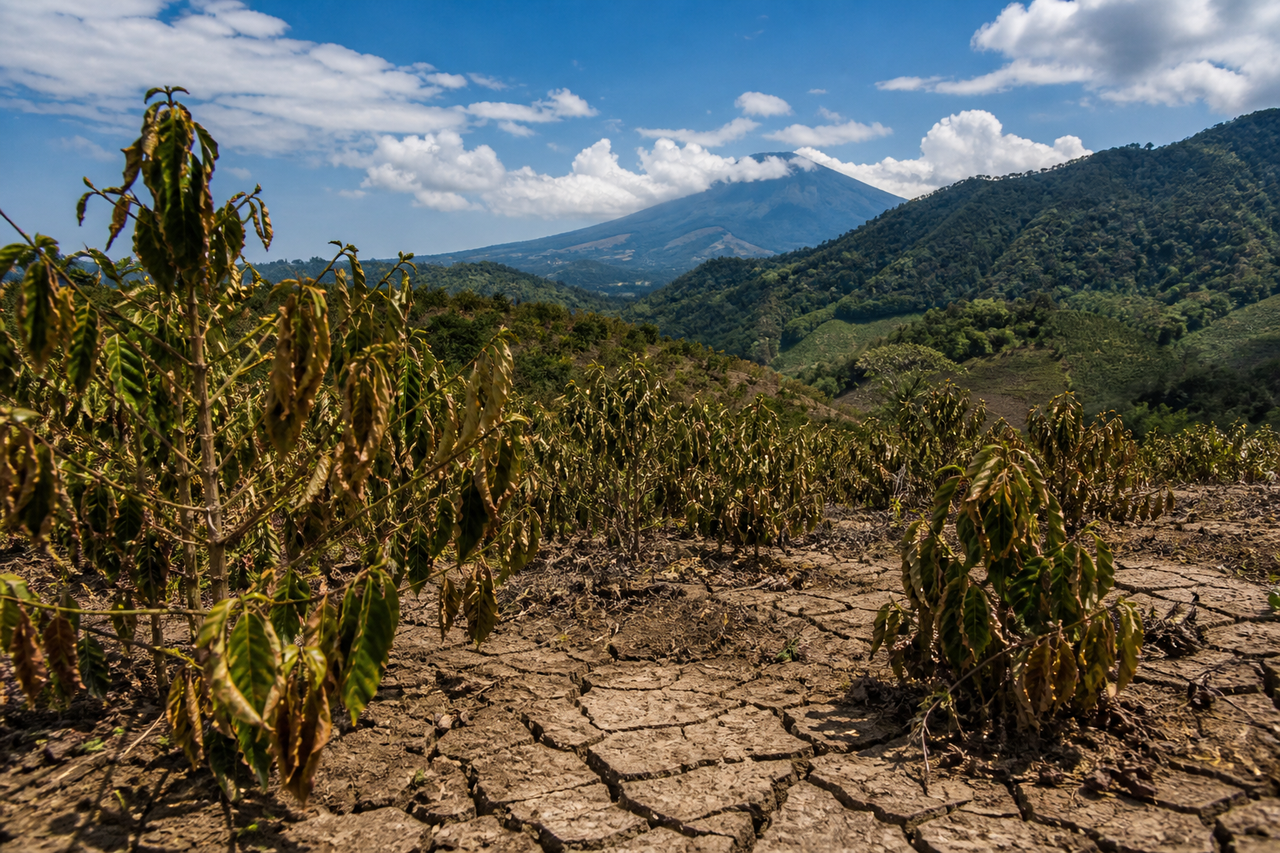
Arabica coffee is grown, in essence, in the coffee belt: a tropical band of about 25° north to 25° south latitude. Temperature, rain and altitude the tree needs coincide there. When that band heats or dries out of season, the market notices. The FAO attributed the 2024 price rise — 38.8% above the previous year’s average — mainly to adverse weather in key countries. Brazil and Vietnam account for nearly half of world production. In Vietnam, prolonged dry weather cut the 2023/24 crop by about 20% and exports fell 10% for a second year. In Brazil, heat and drought forced downward revision of a forecast that had pointed to growth.
The ICO Coffee Market Reports in 2025 followed that trail: Vietnam’s poor 2023/24 harvest left exports at 25.09 million bags, and the later rebound was read in part as a base effect. Brazil, after a period of unusually high robusta shipments, showed months of contraction. The belt is not a static map. It is a climate system that moves.
El Salvador: fewer bags, the same latitude, more altitude
El Salvador sits inside the belt, in the Central American tropics, but its coffee lives on volcanic slopes. That altitude — mid- and high-mountain groves from Apaneca to Metapán and Chalatenango — works as a relative refuge: arabica prefers cooler nights; when heat rises in the lowlands, quality production concentrates upslope. Relative does not mean immune. USDA ES2026-0004, read by Daily Coffee News, projects 542,000 60-kilo bags in 2026/27, against 586,000 in 2025/26: 44,000 fewer bags (−7.5%), attributed mainly to El Niño at flowering and harvest. That count was developed in news item 50; here the figure is enough: the same phenomenon that disturbs Brazil and the Caribbean also cuts the Salvadoran bag.
The genetic answer does not fit on a single volcano. World Coffee Research breeds arabica (and robusta) varieties more resilient to heat, drought and rust. In 2025 it installed Innovea arabica trial sites in seven countries, including El Salvador, alongside Costa Rica, Kenya, Mexico, Peru, Rwanda and Uganda. It is not a magic 2026 seed; it is a breeding pipeline that shortens decades of waiting. WCR has warned that a relevant fraction of today’s arabica land could become unsuitable by 2050 without adaptation.
For the Salvadoran producer, the belt teaches two things. First: a high world price, driven by someone else’s drought, does not replace a well-made flowering at home. Second: renewing with more resistant material — and keeping the altitude, shade and Bourbon or Pacamara the market pays for — is how to stay inside the belt when the thermometer rises. El Salvador’s coffee does not escape the 25°–25° map. It defends itself higher on the slope, with variety science and with the cup that still justifies the work.